
Why the flu season is bad and how you can protect yourself
Clip: 1/2/2026 | 7m 29sVideo has Closed Captions
Why the flu season is so bad and how you can protect yourself
We are entering peak flu season, and a new variant known as subclade k is spreading quickly across the country, driving a sharp rise in illness and hospitalizations. Public health officials say this current wave may last for weeks to come. William Brangham discussed the variant and what to look out for this flu season with Dr. Andrew Pekosz of Johns Hopkins Bloomberg School of Public Health.
Problems playing video? | Closed Captioning Feedback
Problems playing video? | Closed Captioning Feedback
Major corporate funding for the PBS News Hour is provided by BDO, BNSF, Consumer Cellular, American Cruise Lines, and Raymond James. Funding for the PBS NewsHour Weekend is provided by...
Why the flu season is bad and how you can protect yourself
Clip: 1/2/2026 | 7m 29sVideo has Closed Captions
We are entering peak flu season, and a new variant known as subclade k is spreading quickly across the country, driving a sharp rise in illness and hospitalizations. Public health officials say this current wave may last for weeks to come. William Brangham discussed the variant and what to look out for this flu season with Dr. Andrew Pekosz of Johns Hopkins Bloomberg School of Public Health.
Problems playing video? | Closed Captioning Feedback
How to Watch PBS News Hour
PBS News Hour is available to stream on pbs.org and the free PBS App, available on iPhone, Apple TV, Android TV, Android smartphones, Amazon Fire TV, Amazon Fire Tablet, Roku, Samsung Smart TV, and Vizio.
Providing Support for PBS.org
Learn Moreabout PBS online sponsorshipAMNA NAWAZ: We are entering peak flu season,# and a new flu variant known as subclade K is## spreading quickly across the country, driving# a sharp rise in illness and hospitalizations.
Public health officials say this# current wave may last for weeks to come.
William Brangham has the latest.
WILLIAM BRANGHAM: That's right, Amna.
Just this week, according to the CDC, f.. and jurisdictions.
That's nearly double from# the week before.
More than seven million people## nationwide have been infected, and over 3,000# have died so far this season.
Only about a quarter## of adults and just 17 percent of children# have received the flu shot as of November.
So, for more on the variant and what# to look out for this flu season,## I'm joined by Andrew Pekosz.
He's a virologist at# Johns Hopkins Bloomberg School of Public Health.
Andrew Pekosz, thank you so much for being here.
We know flu is a shape-shifter.
It's why# we have to design a new vaccine every## single year.
But this particular strain,# this subclade K, is proving to be quite a## challenge.
Tell us a little bit about it.
Is# it more contagious?
Is it more dangerous?
ANDREW PEKOSZ, Johns Hopkins University: Yes,# well, the first thing we know about this subclade## K virus, which is part of a larger group of# viruses we call H3N2 viruses, is, we know that it## has mutations at a couple of what I call hot spots# on the virus that are the targets of your immune## system and that can generate those protective# antibodies that minimize infection and disease.
So, this clade K virus has changed from# the viruses that circulated last year.
And,## importantly, it also has changed based# on the vaccine that was distributed## earlier this fall and is still available.
So# we think that the first thing that's going## on with this clade K virus is, more people are# susceptible because it's found a way to evade## that preexisting immunity in the population that# is induced by either infection or by vaccination.
WILLIAM BRANGHAM: So is that why we are hearing# reports that the current flu shot that people## can get at the drugstore is considered not# as effective against this particular strain?
ANDREW PEKOSZ: Yes, this year is# what we call a mismatch between## the vaccine strain and the circulating virus.
We know there's a few mutations that will# cause some of that vaccine-induced immunity## to not recognize the currently circulating# virus.
And what usually results from that is,## we end up seeing a drop in the vaccine# efficacy, particularly against infection.
Now, it's important to note that, even in a# year when there's a mismatch of this sort,## we oftentimes still see a signal of protection# against severe disease that's associated with## vaccination.
So just because there's a mismatch# in this clade K virus doesn't mean you shouldn't## take the vaccine.
If you haven't gotten the# vaccine already, still a good idea to take it.
WILLIAM BRANGHAM: It's still --# there's still time to get some## protection out of it for the rest of this season?
ANDREW PEKOSZ: Yes, the influenza vaccine# takes about two weeks for you to generate a## strong immune response to it.
Flu seasons usually# last anywhere from four to six weeks or longer.
So, even if you're in a part of the country that's# starting to experience a rise in influenza cases,## not a bad idea to go get vaccinated because## it'll protect you against the# tail end of the flu season.
WILLIAM BRANGHAM: I want to ask you a# question about public health messaging.
Recently, Dr.
Mehmet Oz, who runs the# Center for Medicare and Medicaid Services,## one of the most prominent doctors in the Trump# administration, was on TV and he was asked about## flu prevention.
And he ticked off a whole slew# of things that people should do, getting more## exercise, getting more sunlight, eating well,# taking vitamin D, sneezing into your elbow.
The only thing he said about the vaccine,# the flu shot, was something like,## we know it doesn't always work# that well and it's controversial.
What do you make of that as a messaging strategy?
ANDREW PEKOSZ: Well, certainly,# the healthier that you are,## the better are you will be# at fighting off an infection.
But there's nothing really controversial about# the influenza vaccine.
We know that it works.## We know that it's safe.
It does vary from# year to year in terms of its efficacy.
But## that's primarily because we have to choose# a flu vaccine six to nine months before our## flu season in order to have enough time to# manufacture enough vaccine to distribute.
And with this clade K variant, for# instance, it emerged after the vaccine## was chosen for the Northern Hemisphere last# February.
So there really was no chance for## us to make a better matched flu vaccine# because of that -- manufacturing issues.
So, again, the vaccine works.
It could# be better, but certainly it works.
And## there's no reason why most individuals# shouldn't take the influenza vaccine.
WILLIAM BRANGHAM: So who is most# at risk from this flu right now?
ANDREW PEKOSZ: Well, everyone can get infected,# but, when it comes to that severe disease, we're## seeing a typical pattern, which is, individual# -- young individuals, pediatric populations,## kids under the age of 11, are one prime# area that is suffering from severe disease.
And then individuals over the age of 65 are# also suffering from more severe disease.
Now,## it's important to note that right now the data# is saying that we're seeing a lot of flu cases## and a proportionate rise in the amount of severe# cases.
So, we're not seeing any data so far that## says the clade K variant is more dangerous to# people than other H3N2 viruses that we have seen.
It's just that more people are susceptible.# And, therefore, we will be seeing more cases## and a corresponding or proportionate# rise in the number of severe cases.
WILLIAM BRANGHAM: Do we know why some areas# seem to be having bigger outbreaks than others?
ANDREW PEKOSZ: Yes, we think that, every year,# influenza, particularly here in the U.S.,## it appears in different states at# slightly different times of the year.## New York was unfortunate to be one of the first# states that really got hit by this clade K virus,## and so we have seen the most experience# in the U.S.
in New York in terms of how## quickly that virus can spread# and how many cases it can cause.
Over the last two weeks, we have# seen many states that have gone## from basically no cases or very few# cases to a very high number of cases.## And we will probably see the rest of the country# see the same thing over the next two weeks## or so.
So it's not uncommon to see influenza# appear in different states at different times.
Sometimes, that's just bad luck.
That's# where the virus lands first and starts## spreading first.
And then it moves from# that area into other parts of the country.
WILLIAM BRANGHAM: All right, that is Andrew Pekosz## of Johns Hopkins Bloomberg# School of Public Health.
Thank you so much for being here.
ANDREW PEKOSZ: My pleasure.
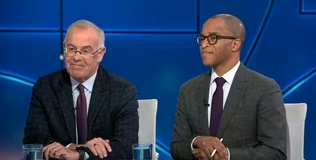
Brooks and Capehart on chances of peace in Ukraine
Video has Closed Captions
Clip: 1/2/2026 | 12m 22s | Brooks and Capehart on chances of Ukraine-Russia talks leading to peace in 2026 (12m 22s)
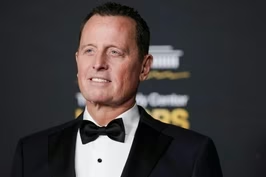
Grenell defends Trump's Kennedy Center takeover
Video has Closed Captions
Clip: 1/2/2026 | 11m 12s | 'We cannot have art institutions that lose money': Grenell defends Kennedy Center takeover (11m 12s)

Kennedy Center faces cancellations after Trump's name added
Video has Closed Captions
Clip: 1/2/2026 | 6m 50s | Kennedy Center faces artist cancellations, drop in ticket sales after Trump's name added (6m 50s)

News Wrap: Investigators say sparklers started deadly fire
Video has Closed Captions
Clip: 1/2/2026 | 5m 42s | News Wrap: Swiss investigators believe sparklers started deadly fire inside ski resort bar (5m 42s)
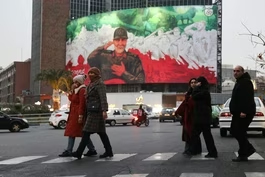
Trump threatens to intervene if Iran kills protesters
Video has Closed Captions
Clip: 1/2/2026 | 8m 35s | Trump threatens to intervene in Iran if regime continues to kill protesters (8m 35s)
Providing Support for PBS.org
Learn Moreabout PBS online sponsorship
- News and Public Affairs

FRONTLINE is investigative journalism that questions, explains and changes our world.

- News and Public Affairs

Today's top journalists discuss Washington's current political events and public affairs.



Support for PBS provided by:
Major corporate funding for the PBS News Hour is provided by BDO, BNSF, Consumer Cellular, American Cruise Lines, and Raymond James. Funding for the PBS NewsHour Weekend is provided by...